
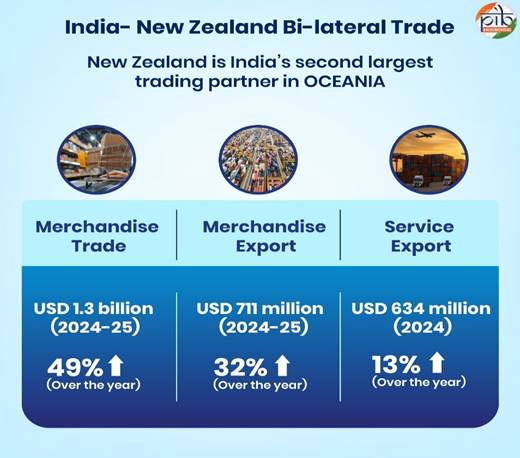
The India–New Zealand Free Trade Agreement (FTA), signed in December, is a landmark step to strengthen bilateral trade and investment. It grants India zero‑duty access for all exports to New Zealand and includes a pledge of $20 billion in Foreign Direct Investment (FDI) by 2030.

Key Provisions
New Zealand will eliminate tariffs on 100% of Indian exports, while India will relax tariffs on 95% of imports, with 57% duty‑free immediately. The agreement promotes skill mobility across 118 sectors, boosting employment in IT, healthcare, education, and construction. It also encourages trade in Ayurveda, yoga, and traditional medicine, and supports youth and student mobility through work permits and post‑study visas.
MSMEs and Sectoral Cooperation
The FTA emphasizes strengthening MSMEs and labor‑intensive industries such as textiles, leather, gems, engineering goods, and processed food. Sensitive sectors like agriculture and dairy remain protected. Cooperation extends to fruit production, with plans for centers of excellence and technical support for Indian growers.
Strategic Importance and Challenges
This FTA is India’s third major trade pact of the year, following agreements with the UK and Oman, reflecting its push into global value chains. However, New Zealand has criticized the exclusion of dairy, while India faces concerns about trade deficits.
Overall, the FTA is a historic framework for deeper economic cooperation beyond tariff reductions.